
The Role of Activated Carbon in CIP Gold Recovery Process
How carbon adsorption, counter-current movement, screening, elution, and regeneration work together inside a CIP circuit
Date: August 10, 2026 Author: YICARB Technical Expert (15+ years experience in activated carbon industry)
Abstract
Understanding the role of activated carbon in CIP gold recovery process design requires looking beyond adsorption alone. In a Carbon-in-Pulp (CIP) circuit, activated carbon is a mobile gold-collection phase that contacts cyanide-leached slurry, captures dissolved gold, moves counter-current to the slurry, passes through repeated screening and transfer steps, and finally carries the recovered gold to elution. The performance of the carbon therefore affects not only adsorption, but also stage efficiency, carbon inventory, screen retention, gold distribution, regeneration stability, and the amount of gold that ultimately leaves the circuit in solution or fines. This technical brief explains how activated carbon functions across the full CIP carbon cycle and which operating signals help indicate whether that cycle is working as intended.
1. Activated Carbon Is a Moving Gold-Collection Phase in CIP
In a CIP plant, leaching and carbon adsorption take place in a series of agitated tanks after the ore has been ground and contacted with cyanide. Gold is first dissolved into solution as a cyanide complex. Activated carbon is then mixed directly with the pulp so that dissolved gold can transfer from the liquid phase onto the carbon.
The key point is that carbon is not simply a stationary filter medium. It becomes part of the process inventory. Carbon particles circulate from stage to stage, accumulate gold, are retained by interstage screens while slurry continues forward, and are eventually withdrawn as loaded carbon. From there, the carbon enters washing, elution, regeneration, and return-to-circuit steps.
This makes activated carbon in CIP gold recovery fundamentally different from a simple batch adsorbent. Its value comes from performing several functions repeatedly: adsorbing gold fast enough, carrying a useful gold loading, surviving mechanical handling, remaining within the intended particle-size range, and recovering sufficient activity after regeneration.
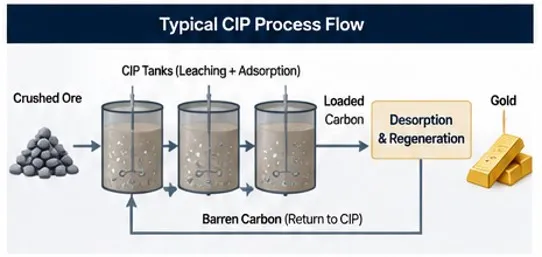 Figure 1: Simplified activated-carbon flow in a CIP circuit.
2. Gold Adsorption: Moving Gold From Solution Onto Carbon
Within the adsorption tanks, dissolved gold is present mainly as a gold-cyanide complex. For recovery to occur, that dissolved species must move from the bulk solution to the external surface of a carbon particle, enter the pore network, and reach internal adsorption sites with sufficient affinity for the gold complex.
Two performance concepts matter here. The first is gold loading capacity: how much gold the carbon can hold under the relevant test or operating conditions. The second is adsorption kinetics: how quickly the carbon captures gold while slurry is moving through the plant. In a multi-stage CIP circuit, fast adsorption is important because each stage provides only a finite contact time before slurry advances to the next tank.
These two properties should not be treated as interchangeable. A carbon may have useful equilibrium loading but still perform poorly if gold transfer is too slow for the available residence time. Conversely, fast initial adsorption is not enough if the carbon cannot carry a useful loading or if it loses activity rapidly during reuse.
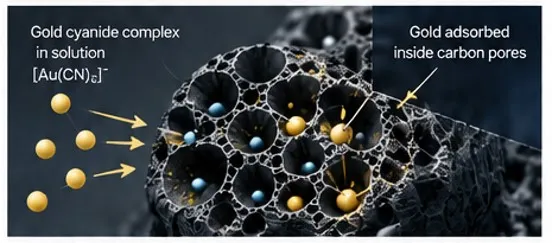 Figure 2: Gold-cyanide adsorption inside activated carbon pores.
3. Why Carbon Moves Counter-Current to the Slurry
One of the defining features of a CIP circuit is the opposite movement of slurry and activated carbon. Slurry normally advances from the first adsorption stage toward the final stage, while carbon is transferred in the opposite direction.
This counter-current arrangement improves the use of adsorption capacity. Fresh or regenerated carbon is introduced near the low-gold end of the circuit, where solution concentrations are already relatively low. Because this carbon has high remaining activity, it can continue removing gold from a solution that would be more difficult for heavily loaded carbon to polish.
As carbon moves upstream, it progressively contacts slurry with higher dissolved-gold concentration and becomes more heavily loaded. By the time carbon reaches the lead adsorption stage, it should carry substantially more gold than carbon in the tail-end stages. The plant can then withdraw loaded carbon for elution while allowing the remaining carbon inventory to continue moving counter-current.
The practical benefit is not simply more contact. The counter-current pattern creates a loading gradient across the circuit. A healthy gradient helps the plant use fresh carbon where the adsorption driving force is weakest and loaded carbon where the dissolved-gold concentration is higher.
4. Carbon Inventory and Stage Loading Profile
A CIP plant depends on maintaining an appropriate quantity of carbon in each stage. Too little carbon reduces the available adsorption inventory and can increase soluble gold in the downstream slurry. Too much carbon can create unnecessary transfer, screening, and handling load without automatically improving recovery.
Operators therefore need to consider both total carbon inventory and how that inventory is distributed through the stages. The useful question is not only how many tonnes of carbon are in the circuit, but where that carbon is, how active it is, and how much gold it is carrying at each stage.
Carbon loading samples can help show whether the counter-current system is producing the expected stage-to-stage profile. If the difference in gold loading between stages becomes unusually small, possible causes include weak adsorption kinetics, insufficient carbon transfer, loss of activity after regeneration, excessive carbon fouling, or changes in solution chemistry.
5. Interstage Screens Keep Gold-Bearing Carbon Inside the Circuit
Interstage screens perform a critical separation function in CIP. Slurry must pass from one tank to the next, while the much larger activated-carbon particles must remain in the intended stage until they are deliberately transferred.
This makes particle-size distribution and mechanical durability process variables, not merely product specifications. Oversize or irregular particles can affect transfer and hydraulic behavior, while undersize particles or attrition-generated fines may pass through screening systems more easily.
When carbon breaks down, the issue is more serious than carbon consumption alone. Fines may already contain adsorbed gold. If those particles leave the controlled carbon circuit, they can carry gold with them and complicate gold accounting. Carbon hardness, attrition resistance, platelet and soft-particle control, and a stable particle-size distribution therefore support both physical carbon retention and gold retention.
6. Loaded Carbon Connects Adsorption to Elution and Regeneration
Once carbon reaches the target loading and is withdrawn from the lead end of the circuit, its role changes from adsorbent to gold carrier. The loaded carbon is separated from slurry, washed to remove residual solids, and transferred to the elution circuit, where the adsorbed gold is stripped from the carbon into a concentrated solution for downstream gold recovery.
After elution, carbon may be thermally regenerated before returning to CIP. Regeneration is intended to restore adsorption performance by removing adsorbed organics and other materials that can reduce access to the carbon surface.
The carbon therefore operates in a cycle rather than a single pass: adsorption, loading, separation, elution, regeneration, and return. A carbon that performs well when new but loses adsorption activity, strength, or particle integrity after repeated cycles can gradually weaken circuit performance even if the incoming product specification remains unchanged.
7. How Carbon Properties Affect Different Parts of the CIP Circuit
|
Carbon Property |
Where It Matters in CIP |
Process Consequence |
|
Gold loading capacity (K-Value) |
Carbon loading and loaded-carbon withdrawal |
Influences how much gold can be carried per unit carbon under defined conditions |
|
Adsorption kinetics (R-Value / rate behavior) |
Each adsorption stage |
Influences how quickly dissolved gold is captured during finite residence time |
|
Mechanical durability: hardness, attrition, platelet and soft-particle control |
Agitation, pumping, transfer, and screening |
Controls early breakdown, fines generation, carbon make-up, and risk of gold-bearing carbon loss |
|
Particle size distribution |
Interstage screening and carbon transfer |
Affects retention, hydraulic behavior, and consistency of carbon movement |
|
Regeneration stability |
Elution-regeneration-return cycle |
Helps preserve adsorption performance over repeated reuse |
8. Operating Signals That Show Whether the Carbon Stage Is Working
A CIP circuit should be evaluated through process trends rather than a single carbon test. Several operating signals can reveal whether the activated-carbon section is supporting the intended gold-recovery performance.
· Solution gold profile across adsorption stages: a rising tail-end soluble-gold level can indicate that the circuit is not removing gold fast enough.
· Carbon gold loading by stage: the loading gradient should reflect the counter-current movement of carbon and the changing gold concentration in solution.
· Carbon concentration and inventory: unexpected depletion can point to transfer losses, screening problems, or excessive attrition.
· Carbon fines in slurry or tailings: increasing fines may indicate mechanical breakdown or poor control of weak particles.
· Screen condition and carbon retention: damaged, blinded, or poorly matched screens can disrupt carbon distribution and increase loss risk.
· Post-regeneration carbon activity: a decline can signal incomplete regeneration, fouling, or cumulative carbon degradation.
These indicators are most useful when interpreted together. For example, elevated soluble gold in the final stage can be caused by low carbon inventory, slow adsorption kinetics, inactive regenerated carbon, changes in cyanide chemistry, or reduced contact efficiency. Replacing carbon without identifying the process cause may not solve the problem.
9. Application Example: Diagnosing a Weak Tail-End Adsorption Stage
Application Example - not a customer case study: Consider a multi-stage CIP circuit where gold dissolution remains stable, but soluble gold in the final slurry begins to increase. The plant initially suspects that the carbon grade is no longer suitable.
A process review shows that the problem should be investigated stage by stage. The team checks carbon concentration, gold loading on carbon, interstage screen condition, carbon transfer frequency, and the activity of regenerated carbon. Samples show that the tail-end carbon inventory is lower than intended and that regenerated carbon is returning with weaker adsorption activity than the plant historically observed.
Instead of treating the issue as a single product-specification problem, the plant restores carbon inventory, reviews regeneration conditions, and evaluates whether make-up carbon is entering the correct stage at the required rate. This example illustrates the role of activated carbon in CIP gold recovery process control: carbon performance is inseparable from how the plant manages inventory, movement, screening, and regeneration.
10. YICARB Perspective: Treat Carbon as Part of the Process, Not Just a Consumable
For gold plants, purchasing activated carbon only by iodine value, hardness, or unit price can miss the way carbon actually behaves inside a CIP circuit. YICARB evaluates gold-recovery carbon around the combined requirements of adsorption, mechanical durability, particle-size control, and stability through repeated operating cycles.
From a process perspective, the most useful carbon is not simply the product with the highest single laboratory value. It is the carbon that supports a stable loading profile, remains inside the screening system, tolerates repeated movement and regeneration, and continues to provide sufficient adsorption activity where the circuit needs it.
Conclusion
Activated carbon is the link between dissolved gold in cyanide leach slurry and the downstream elution circuit. It captures gold from solution, moves counter-current through the adsorption stages, carries the accumulated gold out of the pulp, survives repeated screening and handling, and returns after elution and regeneration to begin the cycle again.
The role of activated carbon in CIP gold recovery process performance is therefore broader than adsorption capacity alone. Gold loading, adsorption kinetics, carbon inventory, interstage retention, attrition resistance, regeneration stability, and stage-to-stage operating control all influence how effectively the carbon circuit performs. When these factors are managed together, activated carbon in CIP gold recovery can support lower soluble-gold losses, more stable plant operation, and more consistent recovery performance.
How carbon adsorption, counter-current movement, screening, elution, and regeneration work together inside a CIP circuit
Date: August 10, 2026 Author: YICARB Technical Expert (15+ years experience in activated carbon industry)
Abstract
Understanding the role of activated carbon in CIP gold recovery process design requires looking beyond adsorption alone. In a Carbon-in-Pulp (CIP) circuit, activated carbon is a mobile gold-collection phase that contacts cyanide-leached slurry, captures dissolved gold, moves counter-current to the slurry, passes through repeated screening and transfer steps, and finally carries the recovered gold to elution. The performance of the carbon therefore affects not only adsorption, but also stage efficiency, carbon inventory, screen retention, gold distribution, regeneration stability, and the amount of gold that ultimately leaves the circuit in solution or fines. This technical brief explains how activated carbon functions across the full CIP carbon cycle and which operating signals help indicate whether that cycle is working as intended.
1. Activated Carbon Is a Moving Gold-Collection Phase in CIP
In a CIP plant, leaching and carbon adsorption take place in a series of agitated tanks after the ore has been ground and contacted with cyanide. Gold is first dissolved into solution as a cyanide complex. Activated carbon is then mixed directly with the pulp so that dissolved gold can transfer from the liquid phase onto the carbon.
The key point is that carbon is not simply a stationary filter medium. It becomes part of the process inventory. Carbon particles circulate from stage to stage, accumulate gold, are retained by interstage screens while slurry continues forward, and are eventually withdrawn as loaded carbon. From there, the carbon enters washing, elution, regeneration, and return-to-circuit steps.
This makes activated carbon in CIP gold recovery fundamentally different from a simple batch adsorbent. Its value comes from performing several functions repeatedly: adsorbing gold fast enough, carrying a useful gold loading, surviving mechanical handling, remaining within the intended particle-size range, and recovering sufficient activity after regeneration.
Figure 1: Simplified activated-carbon flow in a CIP circuit.
2. Gold Adsorption: Moving Gold From Solution Onto Carbon
Within the adsorption tanks, dissolved gold is present mainly as a gold-cyanide complex. For recovery to occur, that dissolved species must move from the bulk solution to the external surface of a carbon particle, enter the pore network, and reach internal adsorption sites with sufficient affinity for the gold complex.
Two performance concepts matter here. The first is gold loading capacity: how much gold the carbon can hold under the relevant test or operating conditions. The second is adsorption kinetics: how quickly the carbon captures gold while slurry is moving through the plant. In a multi-stage CIP circuit, fast adsorption is important because each stage provides only a finite contact time before slurry advances to the next tank.
These two properties should not be treated as interchangeable. A carbon may have useful equilibrium loading but still perform poorly if gold transfer is too slow for the available residence time. Conversely, fast initial adsorption is not enough if the carbon cannot carry a useful loading or if it loses activity rapidly during reuse.
Figure 2: Gold-cyanide adsorption inside activated carbon pores.
3. Why Carbon Moves Counter-Current to the Slurry
One of the defining features of a CIP circuit is the opposite movement of slurry and activated carbon. Slurry normally advances from the first adsorption stage toward the final stage, while carbon is transferred in the opposite direction.
This counter-current arrangement improves the use of adsorption capacity. Fresh or regenerated carbon is introduced near the low-gold end of the circuit, where solution concentrations are already relatively low. Because this carbon has high remaining activity, it can continue removing gold from a solution that would be more difficult for heavily loaded carbon to polish.
As carbon moves upstream, it progressively contacts slurry with higher dissolved-gold concentration and becomes more heavily loaded. By the time carbon reaches the lead adsorption stage, it should carry substantially more gold than carbon in the tail-end stages. The plant can then withdraw loaded carbon for elution while allowing the remaining carbon inventory to continue moving counter-current.
The practical benefit is not simply more contact. The counter-current pattern creates a loading gradient across the circuit. A healthy gradient helps the plant use fresh carbon where the adsorption driving force is weakest and loaded carbon where the dissolved-gold concentration is higher.
4. Carbon Inventory and Stage Loading Profile
A CIP plant depends on maintaining an appropriate quantity of carbon in each stage. Too little carbon reduces the available adsorption inventory and can increase soluble gold in the downstream slurry. Too much carbon can create unnecessary transfer, screening, and handling load without automatically improving recovery.
Operators therefore need to consider both total carbon inventory and how that inventory is distributed through the stages. The useful question is not only how many tonnes of carbon are in the circuit, but where that carbon is, how active it is, and how much gold it is carrying at each stage.
Carbon loading samples can help show whether the counter-current system is producing the expected stage-to-stage profile. If the difference in gold loading between stages becomes unusually small, possible causes include weak adsorption kinetics, insufficient carbon transfer, loss of activity after regeneration, excessive carbon fouling, or changes in solution chemistry.
5. Interstage Screens Keep Gold-Bearing Carbon Inside the Circuit
Interstage screens perform a critical separation function in CIP. Slurry must pass from one tank to the next, while the much larger activated-carbon particles must remain in the intended stage until they are deliberately transferred.
This makes particle-size distribution and mechanical durability process variables, not merely product specifications. Oversize or irregular particles can affect transfer and hydraulic behavior, while undersize particles or attrition-generated fines may pass through screening systems more easily.
When carbon breaks down, the issue is more serious than carbon consumption alone. Fines may already contain adsorbed gold. If those particles leave the controlled carbon circuit, they can carry gold with them and complicate gold accounting. Carbon hardness, attrition resistance, platelet and soft-particle control, and a stable particle-size distribution therefore support both physical carbon retention and gold retention.
6. Loaded Carbon Connects Adsorption to Elution and Regeneration
Once carbon reaches the target loading and is withdrawn from the lead end of the circuit, its role changes from adsorbent to gold carrier. The loaded carbon is separated from slurry, washed to remove residual solids, and transferred to the elution circuit, where the adsorbed gold is stripped from the carbon into a concentrated solution for downstream gold recovery.
After elution, carbon may be thermally regenerated before returning to CIP. Regeneration is intended to restore adsorption performance by removing adsorbed organics and other materials that can reduce access to the carbon surface.
The carbon therefore operates in a cycle rather than a single pass: adsorption, loading, separation, elution, regeneration, and return. A carbon that performs well when new but loses adsorption activity, strength, or particle integrity after repeated cycles can gradually weaken circuit performance even if the incoming product specification remains unchanged.
7. How Carbon Properties Affect Different Parts of the CIP Circuit
|
Carbon Property |
Where It Matters in CIP |
Process Consequence |
|
Gold loading capacity (K-Value) |
Carbon loading and loaded-carbon withdrawal |
Influences how much gold can be carried per unit carbon under defined conditions |
|
Adsorption kinetics (R-Value / rate behavior) |
Each adsorption stage |
Influences how quickly dissolved gold is captured during finite residence time |
|
Mechanical durability: hardness, attrition, platelet and soft-particle control |
Agitation, pumping, transfer, and screening |
Controls early breakdown, fines generation, carbon make-up, and risk of gold-bearing carbon loss |
|
Particle size distribution |
Interstage screening and carbon transfer |
Affects retention, hydraulic behavior, and consistency of carbon movement |
|
Regeneration stability |
Elution-regeneration-return cycle |
Helps preserve adsorption performance over repeated reuse |
8. Operating Signals That Show Whether the Carbon Stage Is Working
A CIP circuit should be evaluated through process trends rather than a single carbon test. Several operating signals can reveal whether the activated-carbon section is supporting the intended gold-recovery performance.
· Solution gold profile across adsorption stages: a rising tail-end soluble-gold level can indicate that the circuit is not removing gold fast enough.
· Carbon gold loading by stage: the loading gradient should reflect the counter-current movement of carbon and the changing gold concentration in solution.
· Carbon concentration and inventory: unexpected depletion can point to transfer losses, screening problems, or excessive attrition.
· Carbon fines in slurry or tailings: increasing fines may indicate mechanical breakdown or poor control of weak particles.
· Screen condition and carbon retention: damaged, blinded, or poorly matched screens can disrupt carbon distribution and increase loss risk.
· Post-regeneration carbon activity: a decline can signal incomplete regeneration, fouling, or cumulative carbon degradation.
These indicators are most useful when interpreted together. For example, elevated soluble gold in the final stage can be caused by low carbon inventory, slow adsorption kinetics, inactive regenerated carbon, changes in cyanide chemistry, or reduced contact efficiency. Replacing carbon without identifying the process cause may not solve the problem.
9. Application Example: Diagnosing a Weak Tail-End Adsorption Stage
Application Example - not a customer case study: Consider a multi-stage CIP circuit where gold dissolution remains stable, but soluble gold in the final slurry begins to increase. The plant initially suspects that the carbon grade is no longer suitable.
A process review shows that the problem should be investigated stage by stage. The team checks carbon concentration, gold loading on carbon, interstage screen condition, carbon transfer frequency, and the activity of regenerated carbon. Samples show that the tail-end carbon inventory is lower than intended and that regenerated carbon is returning with weaker adsorption activity than the plant historically observed.
Instead of treating the issue as a single product-specification problem, the plant restores carbon inventory, reviews regeneration conditions, and evaluates whether make-up carbon is entering the correct stage at the required rate. This example illustrates the role of activated carbon in CIP gold recovery process control: carbon performance is inseparable from how the plant manages inventory, movement, screening, and regeneration.
10. YICARB Perspective: Treat Carbon as Part of the Process, Not Just a Consumable
For gold plants, purchasing activated carbon only by iodine value, hardness, or unit price can miss the way carbon actually behaves inside a CIP circuit. YICARB evaluates gold-recovery carbon around the combined requirements of adsorption, mechanical durability, particle-size control, and stability through repeated operating cycles.
From a process perspective, the most useful carbon is not simply the product with the highest single laboratory value. It is the carbon that supports a stable loading profile, remains inside the screening system, tolerates repeated movement and regeneration, and continues to provide sufficient adsorption activity where the circuit needs it.
Conclusion
Activated carbon is the link between dissolved gold in cyanide leach slurry and the downstream elution circuit. It captures gold from solution, moves counter-current through the adsorption stages, carries the accumulated gold out of the pulp, survives repeated screening and handling, and returns after elution and regeneration to begin the cycle again.
The role of activated carbon in CIP gold recovery process performance is therefore broader than adsorption capacity alone. Gold loading, adsorption kinetics, carbon inventory, interstage retention, attrition resistance, regeneration stability, and stage-to-stage operating control all influence how effectively the carbon circuit performs. When these factors are managed together, activated carbon in CIP gold recovery can support lower soluble-gold losses, more stable plant operation, and more consistent recovery performance.

Products
Solutions
Performance
Markets & Cases
Resources
Manufacturing & Quality
About Us
Contact Us

Copyright © 2026 Guangdong Yicarb Activated Carbon Co., Ltd. All Rights Reserved.