
Carbon-in-Pulp (CIP)
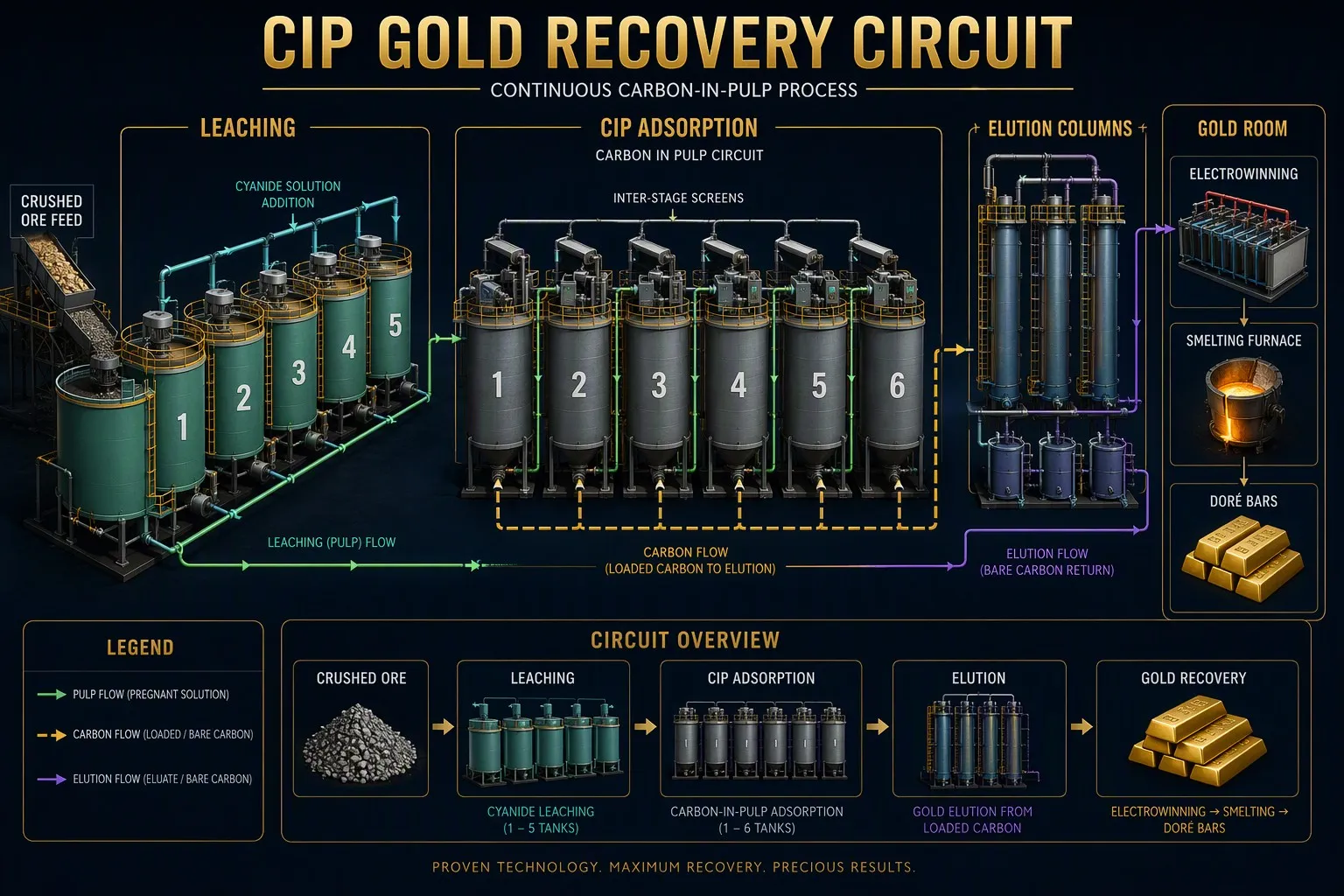
In CIP, leaching and adsorption occur in separate circuits. The ore is fully leached with cyanide in dedicated tanks before the pulp is transferred to a series of carbon adsorption tanks. Since the gold-cyanide complex [Au(CN)₂]⁻ is already fully dissolved and stable, the carbon’s primary requirement is high loading capacity (K-Value). Carbon advances counter-currently through 5–8 stages, with loaded carbon typically containing 3,000–8,000 g Au/tonne before elution. CIP is best suited for ores without preg-robbing characteristics.
In CIP, leaching and adsorption occur in separate circuits. The ore is fully leached with cyanide in dedicated tanks before the pulp is transferred to a series of carbon adsorption tanks. Since the gold-cyanide complex [Au(CN)₂]⁻ is already fully dissolved and stable, the carbon’s primary requirement is high loading capacity (K-Value). Carbon advances counter-currently through 5–8 stages, with loaded carbon typically containing 3,000–8,000 g Au/tonne before elution. CIP is best suited for ores without preg-robbing characteristics.
Other Related Products

Products
Solutions
Performance
Markets & Cases
Resources
Manufacturing & Quality
About Us
Contact Us

Copyright © 2026 Guangdong Yicarb Activated Carbon Co., Ltd. All Rights Reserved.