Acid Washing vs Thermal Reactivation in Gold Recovery: Different Roles in Carbon Maintenance
Why inorganic scale and organic fouling require different maintenance approaches—and how to verify gold adsorption activity and particle integrity after treatment
Author: YICCARB Technical Expert (15+ years experience in activated carbon industry)
Introduction
In CIP and CIL gold-recovery circuits, activated carbon is exposed to mineral deposits, dissolved metals, process reagents and mechanical handling. Over time, these factors can reduce gold adsorption performance or increase carbon losses. Acid washing and thermal reactivation are both used in carbon maintenance, but they do not serve the same purpose. Acid washing is mainly directed at inorganic scale and selected inorganic deposits, while thermal reactivation is intended to remove adsorbed organic contaminants and restore access to adsorption sites. Choosing between them requires identifying the dominant foulant and checking both adsorption performance and particle integrity after treatment.
1. Different Contaminants Require Different Treatments
Carbon fouling in gold recovery can involve inorganic scaling, organic contamination or a mixture of both. Carbonate scale and other mineral deposits can accumulate on the external surface or restrict pore access. Organic foulants may originate from flotation reagents, oils, lubricants, natural organic matter or process water. These substances can compete with the gold-cyanide complex or occupy adsorption sites.
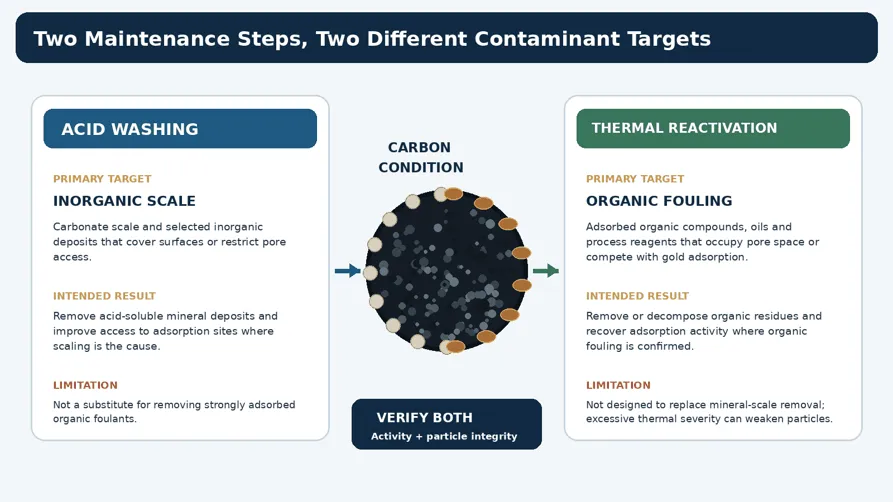
Figure 1: Acid washing and thermal reactivation target different types of carbon contamination.
2. Acid Washing: Primarily for Inorganic Scale
Acid washing is used to dissolve or remove acid-soluble mineral scale and selected inorganic deposits from carbon. A common example discussed in gold-recovery technical literature is carbonate scale, which can cover carbon surfaces and reduce access to adsorption sites. The intended benefit is to remove the inorganic deposit and restore accessible pore space—not to thermally restore the carbon structure.
The effectiveness of acid washing depends on the mineral species, the form in which it is deposited, the condition of the carbon and the plant's established process. Not every inorganic species responds in the same way. Acid washing should therefore be selected from deposit analysis and operating evidence, rather than assumed to remove every form of inorganic contamination.
Acid washing is not a substitute for thermal reactivation when the main problem is strongly adsorbed organic matter. It also does not correct mechanical damage, excessive fines generation or poor screening. The mine's approved procedure, compatibility requirements and safety controls must govern the operation. This article intentionally does not provide an on-site acid formulation, concentration or operating recipe. [1]
3. Thermal Reactivation: Primarily for Organic Fouling
Thermal reactivation—also commonly described as thermal regeneration in gold-recovery literature—uses a controlled thermal process to remove or decompose adsorbed organic species and reopen adsorption sites. Potential organic foulants include flotation reagents, oils, lubricants and naturally derived organics. The objective is to recover gold adsorption activity where organic fouling is a significant cause of performance loss.
Thermal reactivation should not be confused with elution. Elution removes the loaded gold from carbon; thermal reactivation is a separate maintenance step intended to remove organic foulants from the stripped carbon before it returns to the adsorption circuit. [1]
Thermal reactivation is not designed to replace the removal of mineral scale. Inadequate control of the process can also weaken carbon granules, increase abrasion or generate fines. The condition of the carbon entering the reactivation stage, the contaminant loading, equipment design and operating control all influence the final result. No universal reactivation temperature or residence time is appropriate for every carbon and circuit.
A 2020 study of spent carbon from a CIP gold process evaluated chemical and thermal reactivation using both adsorption indicators and mechanical tests. The study highlights why activity recovery and mechanical integrity should be assessed together, rather than judging reactivation by adsorption data alone. [2]
4. Compare the Roles Without Treating Them as Interchangeable
|
Evaluation point |
Acid Washing |
Thermal Reactivation |
|
Main target |
Acid-soluble inorganic scale and selected inorganic deposits |
Adsorbed organic matter and pore-blocking organic residues |
|
Intended effect |
Remove mineral deposits and restore access to adsorption sites |
Remove / decompose organic foulants and recover adsorption activity |
|
What it does not replace |
Organic-foulant removal where thermal reactivation is required |
Dedicated removal of mineral scale where acid washing is required |
|
Main risk to monitor |
Inappropriate treatment or handling can affect carbon condition and process compatibility |
Excessive thermal severity can weaken granules and increase attrition |
|
Selection basis |
Evidence of inorganic scale or inorganic loading |
Evidence of organic fouling and reduced adsorption activity |
Where both inorganic and organic foulants are present, a combined maintenance sequence may be considered, but the sequence and control limits must be established for the specific circuit. A published study of CIP carbon evaluated a combined chemical and thermal reactivation route; that experimental result should not be interpreted as a universal plant procedure. [2]
5. How to Evaluate Carbon After Treatment
A successful maintenance step should improve the relevant adsorption property without causing unacceptable damage to the carbon granules. Compare samples taken before and after each stage, ideally including loaded, eluted, acid-washed and thermally reactivated carbon. Use a consistent sampling plan and a fresh or qualified reference carbon.
· Gold adsorption activity: compare adsorption-rate curves or a defined kinetic activity value under the same solution chemistry, carbon size, temperature, agitation and test time.
· Equilibrium loading or capacity: assess separately from adsorption rate. A carbon may adsorb quickly but reach a different final loading, or vice versa.
· Particle-size distribution: check the retained size range and the generation of undersize material or fines.
· Hardness and abrasion: use a suitable laboratory method to compare particle strength before and after treatment, and where possible assess wet abrasion behaviour relevant to the circuit.
· Carbon yield and physical appearance: record mass loss, visible breakage, dust and any change in the amount of carbon returned to the circuit.
ASTM D3802-23 covers the ball-pan hardness number of granular activated carbon. ASTM explicitly cautions that this test does not directly measure in-service resistance to degradation; it is a measurable comparative characteristic. ASTM D2862 covers particle-size distribution and can help identify changes in the size profile. [4][5]
Iodine number may be retained as a supporting indicator, but it should not be treated as a direct measure of gold adsorption performance. ASTM D4607 describes iodine number as a relative indicator of porosity and states that it does not necessarily measure a carbon's ability to adsorb other species. For gold recovery, use a gold-specific adsorption test alongside physical checks. [6]
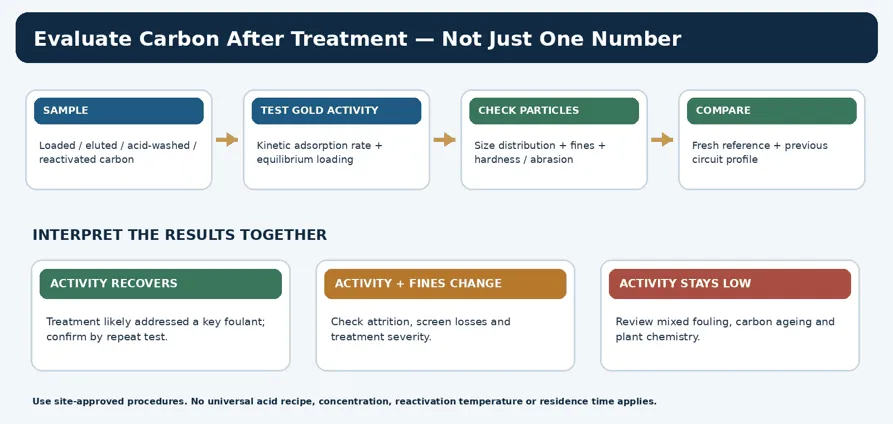
Figure 2: Post-treatment evaluation should combine gold adsorption activity, particle integrity and comparison with a reference carbon.
6. Read the Results as a Carbon Activity Profile
A single sample taken after the final treatment step may show that carbon activity is low, but it may not reveal which maintenance stage is responsible. A carbon activity profile compares kinetic activity at several points in the carbon cycle. If activity improves after acid washing, inorganic scale may have been an important limitation. If the largest improvement occurs after thermal reactivation, organic fouling may have contributed. If activity improves but particle size shifts downward or fines increase, the treatment or handling process may have damaged the granules.
If activity remains low after both treatments, investigate mixed deposits, carbon ageing, sampling quality, elution conditions and changes in the plant solution. Gold adsorption rate and equilibrium loading are separate properties, so both should be considered when evaluating the returned carbon. [1][3]
7. Practical Maintenance Considerations in CIP and CIL
A practical maintenance programme should connect carbon chemistry with physical performance. Keep records of the sample location and carbon state, acid-wash and reactivation history, activity results, particle-size distribution, hardness or abrasion results, carbon inventory and fines losses. Review these trends alongside process conditions such as gold tenor, pH, free cyanide, pulp density, mixing, residence time and interstage screening.
The aim is not to apply both treatments more frequently, but to apply the correct treatment to the dominant cause and verify the result. A carbon that regains adsorption activity but loses too much particle strength may not deliver a better overall result in a CIP or CIL circuit.
Carbon Maintenance Record Checklist
· Identify the circuit, sampling point and carbon state at each maintenance stage.
· Record gold adsorption kinetics and equilibrium loading against a consistent reference carbon.
· Track particle-size distribution, fines, hardness / abrasion and carbon mass yield.
· Log foulant observations, treatment history and relevant process changes before interpreting the results.
Conclusion
Acid washing and thermal reactivation play different but complementary roles in gold-recovery carbon maintenance. Acid washing mainly addresses inorganic scale, while thermal reactivation targets adsorbed organic foulants. Neither should be selected by habit or treated as a universal solution. After treatment, evaluate gold adsorption activity, equilibrium loading, particle-size distribution, hardness, abrasion and carbon yield before returning the carbon to the circuit. This evidence-based approach helps maintain adsorption performance while controlling carbon loss.
Public Technical References and Standards
[1] Rogans, J., Activated Carbon in Gold Recovery, Kemix technical guide, sections on organic / inorganic poisons, acid washing, thermal regeneration and activity profiles. — Practical CIP/CIL carbon maintenance guidance. Source
[2] Cevallos Toledo et al. (2020), Reactivation Process of Activated Carbons: Effect on the Mechanical and Adsorptive Properties, Molecules, 25(7), 1681. — CIP spent-carbon study measuring gold adsorption and mechanical properties. Source
[3] Faulkner, Urbanic & Ruckel (1986), Activated Carbon for Precious Metals Recovery, Society for Mining, Metallurgy & Exploration. — Separate measurement of gold adsorption rate, capacity, thermal regeneration and hardness. Source
[4] ASTM D3802-23, Standard Test Method for Ball-Pan Hardness of Activated Carbon. — Comparative hardness method; not a direct in-service degradation test. Source
[5] ASTM D2862-16(2022), Standard Test Method for Particle Size Distribution of Granular Activated Carbon. — Particle-size distribution and fines monitoring. Source
[6] ASTM D4607-14(2021), Standard Test Method for Determination of Iodine Number of Activated Carbon. — Iodine number is a relative porosity indicator, not a gold-specific activity test. Source
Previous: This is the first one.

Products
Solutions
Performance
Markets & Cases
Resources
Manufacturing & Quality
About Us
Contact Us

Copyright © 2026 Guangdong Yicarb Activated Carbon Co., Ltd. All Rights Reserved.